Saturday, May 29, 2010

5/28 Could have planned this one better!

We joined English Heritage when we first arrived in England, also The National Trust.  Both of these organizations buy and preserve, often restore, many of England's treasures - castles, great houses, gardens and the like, sometimes arranging that the owners and their families can continue to live there in perpetuity.  By joining, we support saving these treasures, but more selfishly and certainly more the reason we joined (have to admit!), we get in free!!

Chiswick House is one of these treasures and right in Hammersmith.  We decided to tour it today along with a visit to another area not far from here - Barnes - which had been described to us by another nice couple we met in another nice pub as a village within the bounds of London.  If we went, they said, we would feel like we were in a village out in the country somewhere.  We also thought we might visit the Fuller Brewery which isn't far from Chiswick but you need to sign up for that and we couldn't get a response from them, making our tour start later in the day than we had hoped.  No matter- both Fuller and Chiswick are a short ride on the same bus that we can catch at the end of our street and can be done anytime.  And so that will be! -  because after taking the bus and getting to the house, we found out that Chiswick is closed Thursday, Friday and Saturday!  Could have checked before we left but we didn't because most of the houses are closed on Mondays and Tuesdays!!   Oh, well, the trip was semi-successful for two reasons - the grounds are lovely and always open and there was a bathroom at the Cafe which was open!

It was a beautiful day so we enjoyed walking through the park and watching the dogs romp and play.  You know, that's one of the joys of England.  Actually, two - there are bathrooms (toilets, as they refer to them) everywhere (thank God!) and you can take your dogs just about anywhere.  In the parks, you are simply asked to keep your dogs "under control" and since dogs go everywhere here, most are very well trained and socialized to mind their owner and their own business.  Many are off lead even on the sidewalks and in the pubs.  There was one particular dog at Chiswick who just ran and ran and ran to the point he had us laughing.  He eventually got near us because his owner was walking toward us and we got to ask her about him.  His name is Gus and he is a working Cocker and runs about two hours a day!  Other than that, she says he is a very quiet dog, even on days he doesn't get to run and spends a good deal of time in her lap!  There were probably about 8-10 dogs there running after balls and Frisbees and swimming in the lake.  All well behaved and paying no attention to each other or the people in the park.

Well, so the plan was on to Barnes and on to Barnes it was.  We couldn't get there from Chiswick by bus but we could by train and John had researched the travel website and found that there was a train station near Chiswick that we could take to Barnes, only two stops down the line.  Everything around here that has to do with transportation is well marked and so we found our way to the station and had only a 15 minute wait for the next train.  There was some discussion between us about which stop to take - the first one, Barnes Bridge, or the second one, Barnes.  We took the second one.  Wrong!  After about a 15 minute walk into Barnes, we found Barnes Bridge right in the middle of town.

Our pub friends were right about Barnes - it is a village within the city and especially village-like with its village green and pond.


 Not all children are angels, but this little girl playing with the ducks plainly believes she is.  She has wings to prove it!


The two pubs we briefly visited were charming and not too updated.  None of the furniture matched.  My favorite kind of pub. 

The interior design shop we stopped in was very upscale and much more fasionable from my American point of view than most interiors that I have seen.  (I subscribe to a real estate firm's postings of English properties for sale and to rent just to see the pictures of the interiors; have for years)  Judging by the real estate postings in the windows in Barnes, this is an expensive place to live and reports are that the likes of Hugh Grant and others reside here.  No sightings, though.  Probably a good thing...

There were many shops here that did remind me of village life - a butcher, a baker, no candle stick maker, a shoe shop, small hardware and clothing to wear.  We stopped in one of the shops that specialized in bread and roasted chickens.  Dinner!  So with chicken in hand, we found a bus to take us back to Hammersmith Station and instead of walking home from there as we normally do, we took another bus to the head of our street.  Other than the brief train trip, we had been walking for hours and my feet were talking to me.  We got home early for us - 5:00.  Usually we don't get in until about 7.  Hardly knew what to do with ourselves.

Another interesting tidbit about London life - the Oyster card - your ticket to all available transportation except a taxi!  Don't ask me why they call it an Oyster card.  It's the size of a credit card and is issued to you in a plastic folder.  The card slips into one side of the folder and the other side is for your use.  The folder opens and closes like an oyster shell and that's the only thing I can figure.  Anyway, you can "top up" the card with any amount of money and when you enter the Underground system or a bus or a train, you slide the card over a yellow disk about 4" in diameter.  It reads where you are and how much money you have on the card.  If you're running low, it tells you and you top up right there at the station.  When you leave the tube or the train, you slide it again and it deducts the amount of your travel based on where you've been.  The only thing I haven't figured out is why you don't do that when you leave a bus.  Maybe the bus is just a flat rate no matter how far you take it, that must be it.  Anyway, it's wonderfully convenient and we had Ginger and Bill get theirs with about £10 on each for their 3 days in London.  You buy them at the tube stations and you can get back any money you don't use.  So when you are in London, get your Oyster card.  Ellen and Phillip keep two on hand for guests and we have been using those since we have been here.  Nice gesture on their part!

5/27 "Never was so much owed......

...by so many to so few."  Winston Churchill  

We returned from Oberammergau on Wednesday and decided on Thursday to tour the Royal Air Force Museum.  Our timing was appropriate since this past week was the 70th anniversary of Dunkirk when 338,000 English soldiers were cornered by the Germans and were rescued by a flotilla of hundreds of small boats captained by ordinary English citizens from across the English Channel, many returning several times.  It is also the weekend of our Memorial Day when we too thank our servicemen for their selfless acts of courage which have given us our freedoms and our futures.  Churchill's reference was to the airmen of the Battle of Britain who fought bravely with more courage than experience.  Their tenacity discouraged Hitler and was one of the turning points in the war.

It was also an interesting contrast to observe these killing and bombing machines just after returning from The Passion Play.  The story of Jesus, a Jew, being crucified by his own kind and the Roman establishment and hundreds of years later, the story of the Jews being obliterated by Hitler's followers and establishment - such a dichotomy with so much in common.  One man against many - one sacred, one evil.

The museum is about an hour and 15 minutes away by foot and by tube.  It's on the grounds of a WWII airbase and houses many original airplanes that were used during that conflict.  John didn't take many pictures because the buildings were so huge and dimly lit.  I couldn't even tell you which one this is because there were so many.


However, this one was the most fascinating for me - the flying boat!  We were able to walk through it.  It was a behemoth and I found it hard to believe that it could ever get off the ground, much less float!

We took a ride in the simulator of a modern day jet that performs aerobatics.  It could have been a disappointment but we were sharing it with a family that had two young children and we invited the youngest, a boy, to sit in the front row with us.  He just had the best time and made it all the more fun for these two jaded adults!

A walk home and a late dinner at the Ottoman, a  neighborhood Turkish restaurant that Ellen and Phillip recommended, rounded out a very much needed quiet day.

5/27 Oberammergau and The Passion Play

When I shared our plans to go to England for three months with a friend at church, she exclaimed that we had to go to the Passion Play at Oberammergau!  I had heard of the play years ago and knew it was only presented one season every 10 years but I had forgotten about it and lost track of when it was to be presented again so I was grateful to be reminded.  Getting John to go, though, involved a bit of arm twisting, however I do believe he is glad that we decided to go.

We arrived in the Munich airport on Monday, 5/24, about noon and boarded the bus with our group to go to Bavaria, Germany where Oberammergau is.  The trip was about two hours and brought us to the village which sits at the foot of the alps.  You can imagine how beautiful is was to see the Alps just suddenly appear over the horizon while on the bus.  In contrast, the approach to the mountains was very flat with small villages in the distance with their signature red roofs.

Oberammergau is distinctive with its winding streets and many homes and stores being decorated with very old frescoes, many dating back to the 1600s.  It is also distinctive because the main occupation of the villagers for hundreds of years is wood carving - the carving itself, the retailing of it, the marketing beyond their village.  So we went with great anticipation of what we were going to see and experience.  Maybe too much. 

We had several hours before dinner so we explored the village, enjoyed a German beer outside one of the many restaurants (not as good as English ale!), and went in many shops.  The carvings are extraordinary; the theme of most is the birth and crucifixion of Christ, of course, which wasn't surprising.  What was was the repetition of the same theme to the point of boredom and disappointment.  Most of the shops had the same merchandise besides the carvings - T shirts, beer steins, key chains, etc. - all with reference to Oberammergau, of course.  I was disturbed by the little creches carved and put into half a walnut shell - in plastic!  And they were everywhere!  I guess someone buys them but we weren't tempted.  The shops that were most interesting to us were the ones that dealt exclusively with the works of one carver and in some cases his workshop would be in the shop.  This house is "Pilot's House" and the fresco depicts Jesus as he stands before Pilot.  It houses working wood carvers and their creations, for sale and not for sale.  A living museum of sorts.

So anytime that we had free, John and I spent walking the village and avoiding the shops.  We spent Tuesday morning walking along the river and venturing Way up the hill towards a crucifixion monument installed in the 1850s that we could see from the village.

John made it and here's a shot of what he saw.  Isn't that beautiful?  He also met some very fine pigs along the way and some residents as well!  He only took pictures of the pigs.

I took the low road through a residential area and had my own adventure wondering where I was going! Trying to avoid the retail and crowded area of the village, I sook out the perimeter of town and walked through the neighborhoods of the locals which is of more interest to me.  The gardens and homes were neat and all very similar - white with red roofs, dark wood balconies carved with cutouts and colorful gardens.

I found a stream whose bed was "tiled" with stone all the same color, closely fitted together- a soft golden yellow.  The sides of the stream were even and made me think that even the streams in Germany - known for its efficiency - were uniform!  The fact that this one had obviously been "tiled" reinforced that perception.  The larger river John and I strolled along beforehand was also very straight along the edges although it had a natural bed.


The play began at 2:30 Tuesday afternoon with a three hour break at 5  (it resumed at 8 to end at 10:30). About an hour beforehand, large travel buses began to arrive and people began streaming down the streets to the 4,720 seat theater.  Now picture this - the play is presented 5 times a week (not on Monday and Wednesdays) and the theater is sold out for each performance.  Somehow, 4720 people are transported, housed and fed every two days, obviously overlapping somewhere!  We were housed in the village at a fairly new hotel, many were housed in village homes and apparently since they were arriving by bus right before the performance my question of where everyone else was "kept" - was answered by that -  somewhere else!  Since there are only 5300 residents in the village, everyone is involved in some way or another.  They are either in the cast, the chorus or the orchestra - that's about 1000 right there - or they are involved in staging, building the sets, sewing costumes, etc.  The rest of the town are housing guests, manning their shops and restaurants, etc.  This picture is of people either arriving for the afternoon show or leaving for the dinner break.  It's hard to tell but it gives an idea of how many people there are in the town for each performance.
I've been trying for a couple of days now to gather my thoughts and emotions about this experience.  My expectations were that I would be very emotional during the play and would need lots of Kleenex.  My experience was that I was really curious how they got the guy who was playing Jesus up on the cross and how they made it look so realistic.  I don't know whether to be disappointed in myself  or what.  It's kind of like when I decided not to go see the movie Titanic because I knew the ending and I knew that everyone was going to die.  I haven't seen it yet despite the number of horrified folks who can't believe I haven't and feel compelled to tell me that I must go see it.  I don't want to.  I know the ending.

Same with The Play - as much as I appreciated the production which was outstanding and truly extraordinary in its presentation -  I knew the ending.  I know that Jesus died for my sins.  I know that by His Grace I have a life everlasting ahead of me.  Maybe having that faith so firmly in place is what led me to more curiosity about the staging than the message.  Perhaps because it was in German and we had to follow along with the English "libretto"; perhaps it had to do with literally being in the dark during the second half and not being able to read the translation until John thought to use the lights on our cell phones as "torches" as they say in England.  At any rate, I am overwhelmed when I think about this village and its descendants of those who made the pledge almost 400 years ago keeping the vow their ancestors made.  The hope I have is that those who don't have the faith I have and who come to see this production will have their faith restored or made new or perhaps come to the Word for the first time.

We were grateful not to be housed outside of town, but right in the middle of town in the Hotel Kopa.  Not being tour-goers but sort of do-it-yourselfers when we travel, we found that the best part was getting to know others in the group that we saw each day, maybe at each meal.  Special people like father, daughter Howard and Mary from the States (she's working in England, he's visiting), Margaret the missionary who lives in Lincoln, David and Angela who live less than two miles from us and their friends Micheal and Diane, a retired physician who says the NHS is great and his wife who live in the county of Shropshire.  Hopefully, we'll cross paths with some of them again sometime.
 
I want to add a couple of shots that show our view from our hotel room - in the daytime and during the night. The first one looks out over the roofs  of the buildings next to us.  By the way, that's not the peak John climbed!  This next one is the steeple of the Catholic church from the same window whose bells rang during the night and especially at 6AM!  Because the steeple is sort of pink, it looks like it glows from within.  When I saw this the first time, I just put my arms on the sill of the open window and stared at it for awhile.  It was so peaceful. 

In contrast to the simple exterior of this church, the interior was Baroque Rococo and was a complete shock when we went in the first afternoon.


There is so much more to share about this short trip but I fear boredom setting in on the part of my reader.  The play runs through mid-October and then is not performed again until 2020.  Should you be traveling in Europe this summer, you might see if you can fit this in somehow.  I believe you need to do it through an agency because of the logistics I mentioned before and we used McCabe Travels out of London.  You could probably Google and find others.

Sunday, May 23, 2010

Baa - Baa- Bahth May 18th - 20th

My title is supposed to get you in the habit of saying Bahth rather than Bath but Bath is the only place other than London where we haven't seen any sheep so it seems totally inappropriate!

We left Oxford around 1:00  Tuesday and arrived in Bath at 3:00.  We had a beautiful drive through the lovely English countryside - again - and I want to mention something that we have seen for many weeks but I've never really emphasized.  This is the season for rape - don't be shocked!  Rape is the plant from which we get mustard seed and it is in full bloom in the spring in England.  It is a brilliant yellow and the fields of it are breathtaking.  You see so much of it that you have to be careful not to get complacent about its beauty.  It really is everywhere when you are in the country.

So after our drive into Bath, we got Ginger and Bill to their B&B.  Fabulous location - on the corner of the Circus, the famous circle of identical buildings, columns, etc and their room overlooks the equally famous Assembly Rooms!   We then drove on to our B&B, Number 30 it's called, where our hostess Caroline spent a good 20 minutes introducing Bath to us with maps and brochures before taking us to our room.  That was a first for us and a very nice gesture.

We walked back to Ginger and Bill's and the four of us walked into the center of town where the Roman Baths and the Abbey are located.  The history of the baths and the discovery of them is quite an amazing story.  In about 60 AD, the Romans discovered a gurgling swampy area where the water was coming up out of a spring and was very hot, about 118 degrees Fahrenheit if I remember correctly, and over several hundred years built a very extensive set of rooms and baths and a temple.  The Romans withdrew from Britain in the early 400s and the baths went into disrepair and "were eventually lost due to silting up" (Wikipedia).  Medieval baths were built over the next many hundreds of years in the same spot but the original Roman baths were lost until about the late 18th century when they were discovered during a construction project.  Since then, archeologists have discovered (the latest being in 1975, I think, or around then) that the baths are much more extensive than they thought.  However, if they excavate further they endanger the buildings above them of collapsing and you can't have that!   More of this later.


The famous Pump Room where Jane Austen drank the waters is literally next door and the Abbey is on the other side.  We briefly peeked into all to determine our schedule for the next day and then headed back over to the Circus for dinner at a restaurant strongly recommended by Ginger and Bill's hosts.  On the way, we had to pass the Assembly Rooms and noticed several police cars and security folks standing around.  In asking what was going on, we were told that Charles and Camilla were arriving at 7:30 to judge some British best chef's competition (oh the things these royals have to do!) or something like that so we decided to stick around despite our 7:00 reservation and we did get to see them!  Camilla had broken a foot several weeks ago so she was still hobbling around but John did get a couple of good shots.  They had to pull up close to the entrance because of Camilla's temporary handicap so most of our pictures were of the back of their heads!  But here's one that's pretty good of Charles and you'll see it better if you click on it to make it larger.


We enjoyed an excellent dinner at the Circus Cafe and parted ways until the next day.

The next morning John and I took Caroline's advice and took the two hour City Walk.  The guides are all trained volunteers and our guide was probably about 78 years old.  We could hardly keep up with him!  This walk was an excellent way to get our bearings in the city and see the influence of the many different eras  of architecture.  The most influential era  on the city was Georgian - the time of the 4 King Georges - the 1700's to the 1800's.  I told John I didn't know whether to describe the city as boringly beautiful or beautifully boring!  What I mean by that is that the majority of the buildings look the same - stone from the same quarry, same roof lines, same doorways and cornices over the doors, same chimneys, same window styles, etc.  In fact, John, who loves to photograph buildings and skylines, etc. took very few pictures of the city which I think is indicative of all this.  The charm comes from the mix of other periods that are interspersed around the neighborhoods like this lovely arch framing a typical Georgian street.

HOWEVER - there are the baths and the Abbey and the Pump Room, all remarkably memorable because of their beauty and the powerful influence they had on their contemporary populations hundreds of years apart.  What amazes me is how the evolution of history has placed them side by side and on top of each other!  Certainly makes it convenient for the present day tourist who hasn't much time to explore!  You just go from one to the next because they are literally next door neighbors.

As we toured the baths after the City Walk, I was overwhelmed with the size and complexity of the rooms and pathways and it all seemed so ancient, even when I came to the source of the water which was captured in the first pool. This is a picture of it below that John took.  Don't ask me how he managed to get what must have been the one split second when there were no tourists in sight because, believe me, there were hundreds of us.  I know you can't see it but right in the middle of this pool there is a constant bubbling and this is the spring where the hot waters are surfacing to the top.  You could see the steam a bit, too.  Still it all seemed a bit surreal until I rounded a corner in one of the areas and there was a drain about 4' across with water just pouring out of it - over one million liters a day!!!!!!!!!!  Still!!!  I was truly stunned.  It all came to life for me right there.  What could those Roman discoverers thought 2000 years ago when they discovered this? 


After the baths, it was time to feed me - it was about 2:30 - and I wanted tea in the Pump Room just like Jane Austen!  John did not and it took some arm twisting to get him to go with me.  It is a bit of a feminine activity I suppose but he wasn't complaining when we got to the scones and clotted cream and chocolate eclairs.  The picture below was the view from our seat and the window you see to the far left is where the Pump Room serves water from the spring and where you can look down right into the Roman baths!  I kind of chuckle when I think of the Victorians in their showy clothes and the Romans in the nude in their mixed baths just below.  Interesting dichotomy, don't you think?


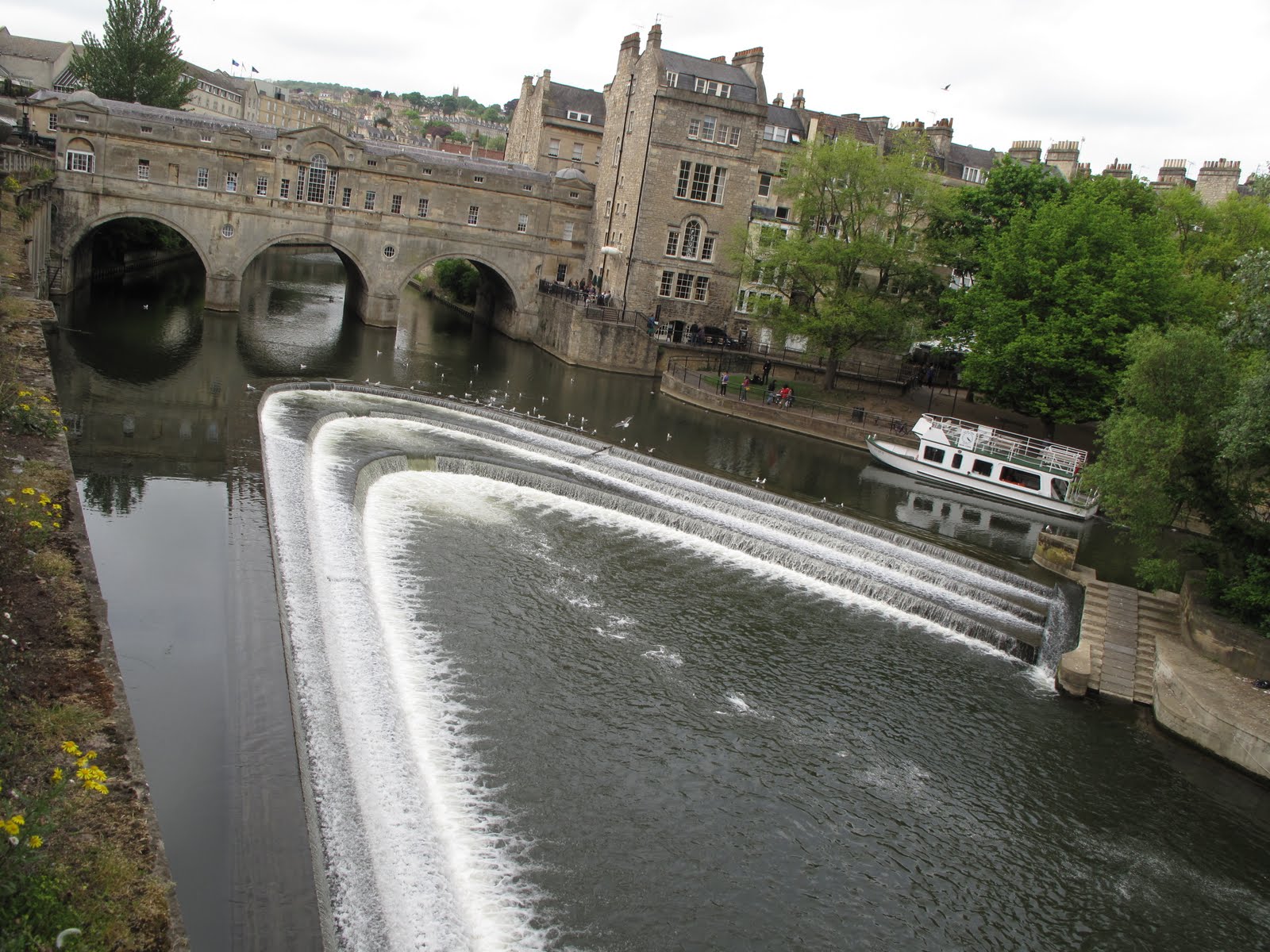
The Avon River flows through Bath and the Pultney Bridge is a beautiful structure that spans it.  There are shops on it and boats beneath it and a beautiful weir constructed to control the flow of water over the drastic drop.   We'll be coming up this river the last week in June in another canal boat with Ellen and Philip.  We won't be able to navigate this part of the river of course, (the canal goes around this part) but we may be able to moor in Bath at this spot and then turn around to head up the canal.


We will have to go through the second deepest lock in Europe on that trip.  We walked over to the canal to see it and it is a bit intimidating.  But that's for another blog!

Early, early tomorrow morning we leave for Oberammergau in the Barvarian Alps to see the Passion Play put on by this village once every ten years for the last almost 400 years.  I am sure it will be an exhilarating experience and I'll be anxious to share it with you when we return.  In the meantime, I want to close with what I think is one of the best shots John has taken this trip. 


Saturday, May 22, 2010

Oxford second time around !

After the quiet tranquility of the canals, off we went to return to the chaos of Oxford with all its bicycles, students and buses!  And for one reason only - to stay at The Bath Place Hotel which is right next to The Turf Tavern!  We fell in love with both places when we were in Oxford for May Day and decided it was worth a stop on our way to Bath after canal boating for a week.

The Bath Place Hotel is a conglomeration of cottages from the 1600's all higgledy piggledy together down an alleyway with a tiny courtyard in the front.  They were originally weavers' cottages built up against the city wall.  The history of the buildings can be read in the history portion of the hotel's website and is worth the read.
(http://www.bathplace.co.uk/history_of_bath_place.html   or just google it if that doesn't work.)

In the eighties, before it was purchased and made into a hotel by the present owner, Richard Burton and Liz Taylor rendezvoused in the pink cottage portion that is now the hotel lounge and I spent a wonderful hour in there by myself before bedtime reading the paper, enjoying a shot of Bailey's and feeling like Miss Rich Bitch!


The quaintness of the hotel is part of its charm.  So are these stairs from our room and while attempting to go down while carrying a suitcase I felt a bit like I was taking my life into my own hands - or feet, in this case.  My size 7s didn't even fit on each riser and I had to go sideways down each step.  Fun, though.


We discovered the hotel when we found the Turf Tavern on May Day.  During that trip, we had dinner in The Old Tom, another wonderful Oxford pub, and struck up a conversation with a group of young men at the table next to us as we always seem to do.   They told us that if we love old pubs, which we must have told them we do, we must find the Turf which is hidden down several alleys and unless you know it's there, you aren't going to find it.  We were in Oxford the next morning at 6AM  for the May Day celebrations and since the streets were still packed with students at 7, we decided the Turf would probably be open.  So we went to find it and it was! And still packed with revelers.  The entrance we found to The Turf is off the tiny courtyard of the Bath Place and upon spotting the hotel, we decided we had to explore so in we went.  We knew then that we just had to have the experience of eating and drinking at The Turf and going off to bed in the Bath Place.  Two rooms were available for May 17th and so were we, so plans were made!  This picture is from our room down into the inner courtyard of the Turf.  Fortunately, the pub closes at 11 and we didn't mind the hurgledy gurgling burble of conversation below our window.

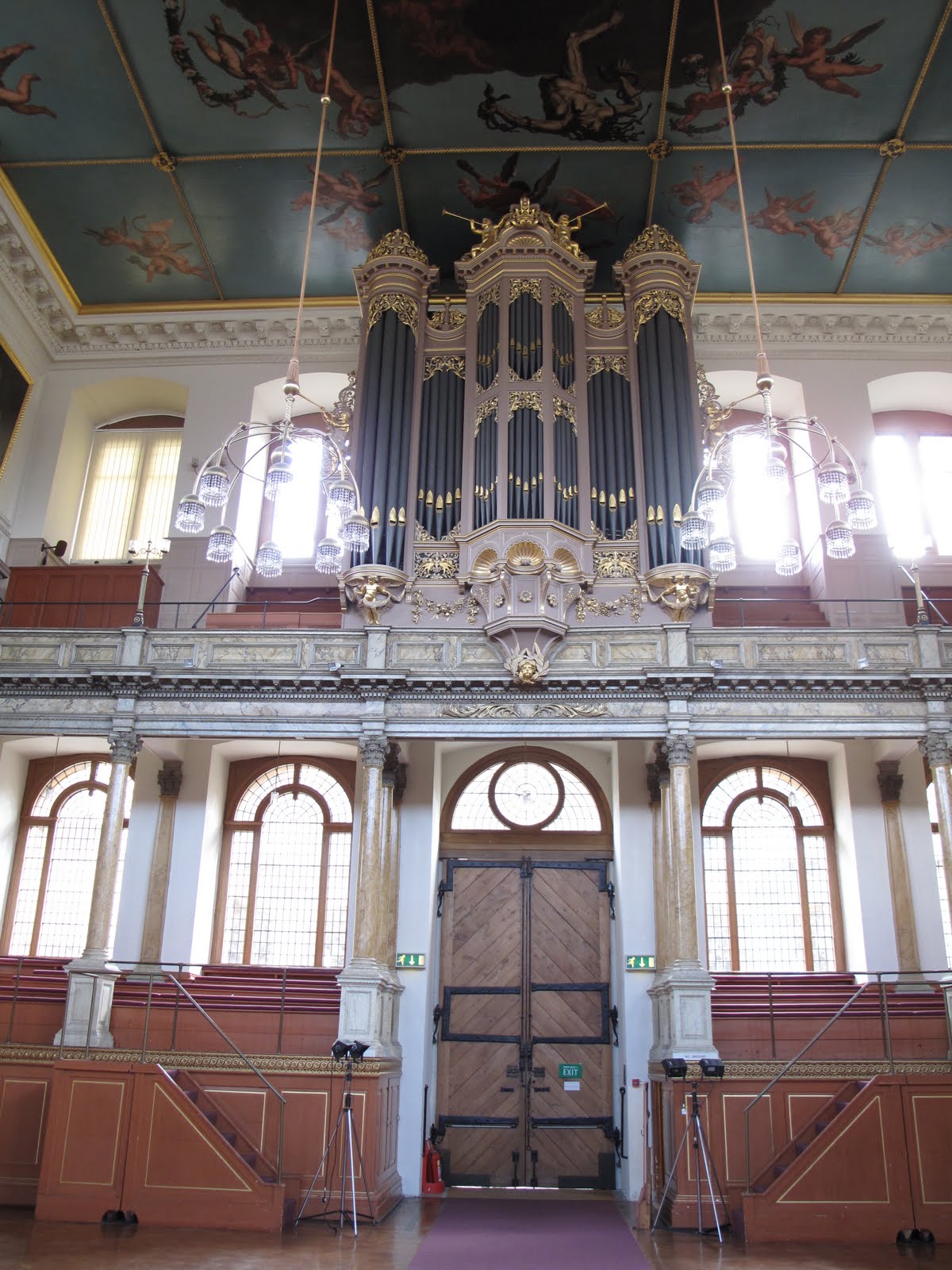
Unfortunately, Bill's cold was pretty bad by this time and he and Ginger spent more time in the Bath than was ever planned sleeping off his cold.  So John and I were on our own that afternoon and the next day to explore the parts of Oxford we had missed a couple of weeks before.   First we took in the Sheldonian Theatre, an octagonal building built in the 1600's and designed by Christopher Wrenn, the architect of St. Paul's and hundreds of other projects.  The main room is absolutely dramatic, a circular arena decorated in marble and gild and the auditorium where each Oxford student matriculates and graduates.  The ceiling was an allegorical marvel which we unfortunately did not photograph but once again,you can google it and get a pretty good picture.  Google "Sheldonian theater ceiling" as I did to get a picture of it. 
'

Up more stairs we went into the cupola of the Sheldonian to get a panoramic view of the Oxford rooftops - rooftops being an understatement for sure!  What a sight.

And on our way up to the cupola, we also got to see the ingenious way Wrenn designed the building.  The room was to be round with a 70 foot span without columnar support and since there were no beams available that long and strong enough, it had to be done ingeniously which is what Wrenn did so well anyway.  Wikipedia has a great explanation of the theater's construction that is worth visiting. 


It was now time for the walking tour with Stuart, the tour guide, which you can catch across Broad Street from the Information Center several times a day.  It was pretty good because he took you into several colleges that you wouldn't have been able to enter and you could see the beautiful gardens and courtyards frequently closed to the public.  We took Stuart's last tour for the day and I would suggest an earlier one when he might have a fresher attitude toward his participants and his job than toward finishing his day.  The interiors of the colleges are magnificent and New College, which is ironically the oldest, is one of the prettiest and the setting for several Harry Potter scenes.

The next morning after a leisurely and generous continental breakfast at The Bath Place,  we toured Blackwell's Book store while Ginger and Bill went to the doctor's!  Blackwell's  has the largest room of books in Britain and Bill heard that it has "3000 miles of book shelves".   Getting John out of a bookstore is like getting him out of the hardware store but I think it was so overwhelming and our time so limited that he gave up before he got hooked.  Ginger and Bill are with us here in London (May 22nd) as I write this and Ginger said she was on the 4th floor in used books on our first visit to Oxford and Bill said he could have stayed there the whole day.  If you are a book lover like we all are, visit Blackwell's with trepidation for fear you may lose an entire day of your holiday or many hours in there.  But then, what are vacations for if not for doing what you want when you want and not having to judge the value of your activities!

Off to Bath - and American friends - that's pronounced Bahth!  Like bah, bah, black sheep......

Friday, May 21, 2010

This is a long one - get comfortable!

I wrote this on May 10th and it was a travel day – from Ludlow and the beer festival to Leighton Buzzard to board our narrow boat, Cedar.  Ginger and Bill got to the boatyard about an hour before we did.  It should have taken us about 2.5 hours to get there, but we saw warnings over the highway about long delays on the M40 so we got off and instructed “Gertrude” our GPS to avoid highways.  Wow!  Did she ever!  We were doing a roundabout about every 2 miles, sometimes sooner.  When we got beyond the point of delays on the M road, we got back on the highway route and got to Leighton Buzzard about 1:40.  We unloaded our belongings into the drawers and closets of our respective “bedrooms” and the four of us set out for the grocery store.  Loaded up with our goodies, we got back in time for our directions with our instructor.  How to turn on the hob (range burners) and oven, how to flush the toilet, how to turn on the lights – you know, all the important stuff and oh, yes, how to drive this thing. 

Cedar is 65 feet long and 7 feet wide.  It definitely lives up to its name of narrow boat.  Top speed is 4 miles an hour – it weighs 16 tons, give or take a few – and when you want the front to go right you push the tiller to the left.  It also turns from the center point.  I don’t mean that it bends but the back and the front go equal distances when you turn it, kind of like a compass, and it takes a while to turn it so you have to think ahead.  We got our first – and only – lesson from our instructor who went with us for about a mile to the first lock.  After directions on how to get through the first lock, he left us!  On our own, we soon hit the side of the boat on a bridge, but it was a very narrow bridge and we’ll never tell who was driving!

(The above picture was taken a few days later when Ginger and I went walking on the tow path and it shows the length of the boat.)

We proceeded on for about a mile through bucolic English countryside marveling at the scenery, checking out all the boats that are moored “permanently” that people live in, some beautiful, some looking like derelicts.  I say “permanently” but you are only allowed to moor for up to two weeks in one spot and then you have to move on.    We went on through the next lock, which of course was different than the first lock, then went a little further and moored on the tow path side for the night.  You are supposed to – and want to – moor on the tow path side because that is where the pathway is to walk on when you get out of the boat.  It’s also the pathway where the donkeys or horses used to tow the boats in the day when the boats were a primary mode of transporting goods.

To give you a little history on the narrow boats and how this recreational activity came about, in the late 1700’s, land owners who were mining coal in the north of England wanted a faster way to get the coal to the industrial parts of the country where manufacturing was going on – like Birmingham and London.  It was realized that transporting by water rather than over land would be quicker and cheaper so they began to dig these canals, narrow ones because that was faster and cheaper, and build the narrow boats to go along them.  The narrow boats were loaded with the coal so that it was piled high from back almost to the front, the front being left open for a living area.  However, that living area was very small and families lived on the boats.  You need to imagine raising a family in an area about the size of our VW camper only smaller!  There is a lot of history to be read about how this group of people lived and survived and its culture.  The book I had and passed on to Ginger to read is “Ramblin Rose, something, something” (neither Ginger nor I can remember the name) and the women worked especially hard to keep the children and their clothes clean so they could go to the schools along the way and not be embarrassed being coal kids. 

The boats were towed by donkeys or horses and they pulled the boats by walking on one side of the canal, thus the term “towpaths”.   When the boats had to go through tunnels, the donkeys couldn’t pull them, of course, so the owner of the boat and maybe his children would lie on top of the coal on their backs and push the boat through the tunnel with their feet, a very dangerous occupation indeed!  There were also men you could hire called “leggings” who would do this for you.

The locks are, of course, devices to lower or raise the boat because the water level changes according to the slope of the land.  They are made of two sets of two large wooden gates that contain hidden paddles that can be raised or lowered to allow water to enter or leave the lock to fill it or empty it.  The paddles are raised or lowered by your crew members who use a windlass or lock key to raise or lower the rack and pinion that are connected to the paddles that are at the bottom of the gates.


Pubs began to be opened along the canals to provide places to eat and probably shop and probably a place for the men to meet.  Many of them still exist today and we tried our best to visit as many as we could if only for a look-see!  Here's a favorite - the Hag's Head about 100 yards from the canal - far by most standards.


 Anyway, in the mid-1800’s when the trains started to be built, coal began to be moved on them and over the years, the canals began to be unused and deteriorate.   Around the 1950’s I think it was, people began to realize that the canals were an important part of their history and also a recreational possibility.  Volunteer groups formed and began to dig the muck out of the canals and restore them.  Our Philip, who we are exchanging houses with, remembers volunteering as a teenager – I think in the 60’s – on the Kennett Avon canal.  Coincidentally, that is the canal that we will be travelling with Philip and Ellen when they return to England the week before we leave.  The British Waterways Board was formed and is now a “public corporation accountable to the Department for Environment, Food and Rural Affairs” and if you are on the waterways you go by their rules.   For difficult lock areas, like Devizes where there are 29 one right after another, there are employees available to help.  

So now, people like us get to ride through this beautiful countryside in style.  Our boat is equipped with two bedrooms en-suite as they say here (private bathrooms) with showers, a full working kitchen, “lounge” with folding table and chairs and an l-shaped settee.  A TV, CD player and cassette player are also provided.  Toaster, coffee pot, and other utensils are all provided – everything except the microwave!  Our interior is rose and teal!  The only thing we needed to bring was our clothes and our food.  If you ever get the chance to do this, you must!  John has put a video walk-thru of the boat on his facebook page that is kind of fun to watch.

After mooring the first night, we walked to a thatched pub in the nearby village called the Carpenter’s Arms that we had visited almost exactly 6 years ago on our fist trip.  A lesson in “you can’t go back” – the pub was there but we learned it had closed down at one point and reopened.  (By the way, England is losing about 40 pubs a week and I believe it was either Samuel Johnson or Pepys who said that “when England loses her pubs, she has lost her heart.”  The Border Collie that lived at The Carpenter’s Arms who would jump up on the bench next to you and grab your coaster so you would play with him (his name was Brie) was gone and the new owner took out all the old pub furniture and put in high backed leather chairs in the restaurant area and leather barrel chairs near the fireplace.  I’m sure it’s much more comfortable for the locals but I find the appearance rather jarringly out of place.  However, I’m grateful this guy bought it for £500,000 and was willing to take the chance.  He was there and John and Bill got to talking to him.  Apparently, quite well off, he owns other restaurants in London and recently sold his helicopter!  All we know is that his name is Allen and he gave the guys a couple of restaurant names and told them to tell these places that Allen referred us and they would take care of us!  You never know who you are going to meet in a pub!

There also was an old fellow at the bar who flew Liberators in WWII and enjoyed talking with the guys.  Ginger and I left early because we were hungry and they weren’t serving dinner on Mondays.  Bill told us when they returned to the boat that this old fellow also said that he had 65 steps to get home but if he goes 66, he doesn’t know where he is and has to go back to the pub and start over! 

(Hey, a Wiemerauner (sic?) just walked by and stuck his nose up to the boat window to see who was in here.  You have to realize that when you are standing in the boat, you are at eye level with walkers’ knees and dog’s noses as they pass by!)

Ginger and I played house when we got back to the boat and got the table set up for our cheese and crackers dinner.  The boys made sardine sandwiches (who would know they had that love in common!), we looked at the photographs John had loaded on his computer of our days in Ludlow and decided it was time to call it a day – another beautiful day in England.


Sunday morning – May 16th

We have been on the canal boat for six days and it’s been a wonderful time. 
We got into a routine of waking up around 8, making coffee and having breakfast and taking as long as we wanted to do that.  When the time felt right, we would get the engine going and we’d be off.  Ginger and Bill took over immediately doing the locks and got quite good at it.  John, and occasionally I, would motor the boat into and through the locks.   As I said, the boat is 65 feet long and 7 feet wide on the outside.  The locks are about 15-16 feet wide and 70 feet long or a little more.  The trick with keeping the boat stable in the lock is to constantly put it in forward gear, then neutral, then reverse and back again to keep the boat from getting too close to either end of the lock.  This takes almost constant vigilance because as the lock is either filling up or emptying, the force of the water pushes the boat one way or the other.  If you spot a place on the wall of the lock and line it up with a spot on the boat, you can keep adjusting the boat to keep it in place.  The only danger is getting the bow or stern caught on the cill (that is the correct spelling!) of the lock (a ledge that juts out from the gate) and have that end of the boat rise up out of the water.  I’ve heard others say that they have seen it happen but we haven’t nor have we had it happen to us, thank goodness.  I fine handling the boat in the locks much more fun than opening and closing the locks.  Fortunately, Ginger and Bill preferred handling the locks so it all worked out.  You can see them triumphing below.  That's our boat again.


We’ve seen some beautiful scenery and sights along the canal.  Most of this portion of the Grand Union Canal that we have traveled has been in the unspoiled English countryside.  We have passed through many pastures and parks and we have marveled at the vistas that we have seen and photographed.  There have been many grey herons that have accompanied us, or maybe it’s the same one that flies away and waits for us further on, and ducks and swans.  Because it’s Spring, we’ve also had the pleasure of seeing their ducklings and signets.  Boy, can those tiny little feet propel those youngsters along!   We saw one swan on her nest very close to the canal edge with hubby keeping watch alongside.  The nest was probably about 3’ across and about 8-12” deep.  I didn’t realize that it would be so big but they are pretty big fowl so it seems appropriate.


Two nights in a row we moored at my favorite spot – at Grafton Regis where John and I had moored on our last trip on this canal in 2004.  This particular spot has open fields on either side with a herd of sheep and their lambs.  We all walked up to the pub in town but it’s my least favorite ever so Ginger and I decided to walk back and view the lambs.  We hoped that they would do what little lambs are famous for – running and playing through the fields with their contemporaries.  When lambs get to running and playing they sometimes jump straight up in the air like a jack-in-the-box and when you get to see a bunch of them doing it, you can’t stop laughing at them.  Ginger would try to encourage them to play by calling to them and saying things like “Come on, little guy, come over here” , etc.  During her conversation with one of these little guys, I turned around and saw a fellow walking down this dirt road toward us and sort of grinning at us.  I said to Ginger that this guy was going to think we were nuts when he said “Don’t they have lambs in America?”  We had to quickly justify our city behavior by telling him there weren’t many roads near us with lambs on them that we could talk to!  He got as good a  kick out of our antics as we did from the lambs!

By the way, Grafton Regis is a famous village because back in the 1400’s, Elizabeth Woodville waited for Edward IV’s progression to come by so she could plead for her inheritance that had been absconded from her by some male relative when her husband died.  Edward not only gave her her inheritance back but fell in love with her and secretly married her at the heritage or church in Grafton Regis which was on this road where we walked.  The church whose tower we could see across the fields from our mooring was 13th century and was there when Edward and Elizabeth met.  One of their sons became Edward VII whose son was Henry VIII so they turned out to be Elizabeth I’s great grandparents!  Pretty important event, then, wasn’t it!!!

Things like that are what fascinate me about England.  I guess in our country we have historic spots, too, like where George Washington slept, or Thomas Jefferson farmed or whatever, and maybe if I read as much American history as I have English I would feel differently but I haven’t and I don’t so that’s the way it is.
 
This is our boat moored at the same spot from which we took the picture of the Grafton Regis church tower.  We're up near the church to get the shot.  Those are some of "our" sheep!

One of the pubs we stopped at both coming and going was The Nag’s Head in Great Linford.  I pictured it earlier. It was Pub of the Year not too long ago and has had little change over the centuries.  You probably can Google it.  It’s ceilings are so low that when a very tall man and his very tall son (maybe they were around 6’4”) came in, they never did straighten up until they sat down!


 During both visits, there was a very old man there that we struck up a conversation with – Alf Dudley.  He was sort of a sad story – hasn’t had any communication with his ex-wife and children and grandchildren for nine years and that’s the way he likes it!  Other folks came into the pub to visit with him and he seemed rather likable so the curiosity was killing us but we never learned much more.  He did say when we asked him his name that his ancestors went back to Elizabethan times and were associates of the Queen.  One of her favorites was Robert Dudley so I think he might have meant his family but I never got the chance to ask. I wonder, though, that if I stare at this picture long enough if I could imagine what his ancestor and Elizabeth's love looked like!


By the way, I don’t believe that I have mentioned that our trip is 7 days and you have to return the boat back to where you got it by 9:00AM Monday, so you plan your trip to go 3.5 days and then turn around and come back.  We didn’t go as far as we could have so we had very slow relaxing days on the way back.  That will explain, if you were wondering, why we moored twice in the same spot and knew where we wanted to stop on the way back.  It was also good because Bill had gotten a wicked respiratory thing and he had lots of opportunity to sleep without missing much.  He also stayed “isolated” in their “room” so we wouldn’t get much exposure to him and Ginger was able to make up the bed in the lounge area for herself so they both could sleep better at night.  It’s amazing how much room these little boats have but I wouldn’t want to have more than 4 adults on it even if it does sleep 6!

We went as far as through the Blisworth Tunnel which is 3000 meters long or 1.86 miles and turned around about 30 minutes beyond it to start back.  It is very dark in there and very narrow so it is a feat in itself when another boat is coming the other way.  In order to see better, we were instructed to turn on the headlight and ALL the lights in the boat so the light from the windows would light the sides of the tunnel and help you see.  We also had a very good example of seeing “the light at the end of the tunnel” and understanding the optimism of that phrase!  It’s very wet in there, too, because there is constant dripping.  Also, the tunnel was built by first digging very deep shafts that workers would go down to dig out the tunnel by hand (remember, it was in the 1700’s!).  Of course, those shafts still exist and there is a LOT of water dripping from them.  You wear your raincoat while you are in there or use your “brollie” – that’s umbrella in British!

Turning this boat is an art in itself and you can only do it at “winding holes” which is pronounced like the blowing wind not like winding the clock!  It is a large V or U shape cut out on one side of the canal and you steer the bow of the boat into it and back up to the other side of  the canal ( no steering available when in reverse!) and then go back into forward and turn the boat to go back in the direction you were coming.  John is quite good at it! 

We returned to The Globe pub late Sunday morning.  This was our last destination before we had to be at the boatyard the next morning at 9AM and was only about 30 minutes away.   It is also the site of The Great Train Robbery (http://www.pub-explorer.com/beds/pub/globeinnlinsladehistory.htm for your information).  Our early arrival gave us the rest of the day for sleeping, reading, walking, and eating at The Globe, there in the background of this picture with our boat!  A very nice way to end a very tranquil week.


Because it takes such a long time to load pictures on to this blog site, I refer you to John’s Facebook page to see the many he took along the way.  He is listed as John L’Engle Graham.

Monday, May 10, 2010

Beer tastings in Ludlow

Friday night we went to the first event in the beer festival and it was the beer tasting, a great way to start a weekend!  One of the things you have to remember here with what appears to be a fixation on beer is that beer over here is like wine in other countries.  We have wine tastings, they have beer tastings;  we have wineries popping up all over the place, they have had micro-breweries for centuries.  We go to restaurants for a nice quiet evening; they go to pubs to visit with friends and have a rip-roaring good time.  The pub has been the center of the community and a way station for travelers since the 1300s, maybe earlier and frequently was part of the abbey.

At this tasting there were over 50 breweries represented showcasing over 140 beers.  That's pretty hard to do but we tried our best!  The picture above was soon after the tasting opened.  Several hours later when we left it was shoulder to shoulder!  The picture below is taken looking down between the two rows of kegs and is the cooling system of water running through tubes to the thermal blankets covering each keg.  They really know their stuff here!

Fish and chips for dinner and off to bed for the festival and walking on Saturday.

Saturday held good old English weather for us - cold and rainy.  Amazingly, in all our trips over here, we've not experienced the weather that is England's reputation, so we considered this kind of fun.  Muddy, rainy, lots of people, castle, kiosks of sausages, sweets, breads, and of course, the beer which was still available.  Touring the castle was great fun and I mentioned it in the last blog, so I was determined to tour a large square home right outside the castle walls reported to have Elizabeth I interiors.  I went alone and the man who answered the door looked like someone out of The Adams Family!  I thought, oh boy, I'm in trouble here.  He had a horrendous wig on about the color of dried wheat that was straight and long, hanging over his eyes and collar.  His skin color was about the same and he had red, rosy cheeks and watery eyes.  But after telling me what rooms I could look at, he disappeared behind a door, much to my relief, into a private area.  (Maybe he was a ghost!)  


The fright was well worth it, though, because this house was a treasure trove.  The paneling and windows and floor boards were definitely original Tudor and it was occupied during Elizabeth's time by some of "the richest people in England", to quote my ghostly host.  After touring it with my mouth gaped open in astonishment most of the time, I went and found John and insisted he pay the £3 to tour and photograph it.  I'm adding a couple of pictures here and later in the week John will add more to his facebook page and www.theklube.smugmug.com that I mentioned in another blog. 

Saturday evening we went to a concert at the church down the street from the B&B.  We had noticed the sign on the church gate for the Ludlow Symphony and listed were a number of ambitious selections for an amateur orchestra, so we decided to go.  They were excellent and our admission was only £7 each.  That's the OAP price or senior, OAP standing for Old Age People!  Not very politically correct but we're not complaining!


Sunday morning we stayed in Ludlow to hear the church bells scheduled to peal from 10:30 to 11:30 then we were off to Stokesay Castle, the village of Much Wenlock and Iron Bridge where the industrial revolution started and a couple of other sites.  We didn't get it all in because we ran out of time.  I have also run out of blogging time because we are packing to take off for canal boating for a week.  I have no idea if we will find any way to blog or answer emails for the next week.  If you would like to get an idea what we are doing, google "narrowboats england" and you'll get a good idea.